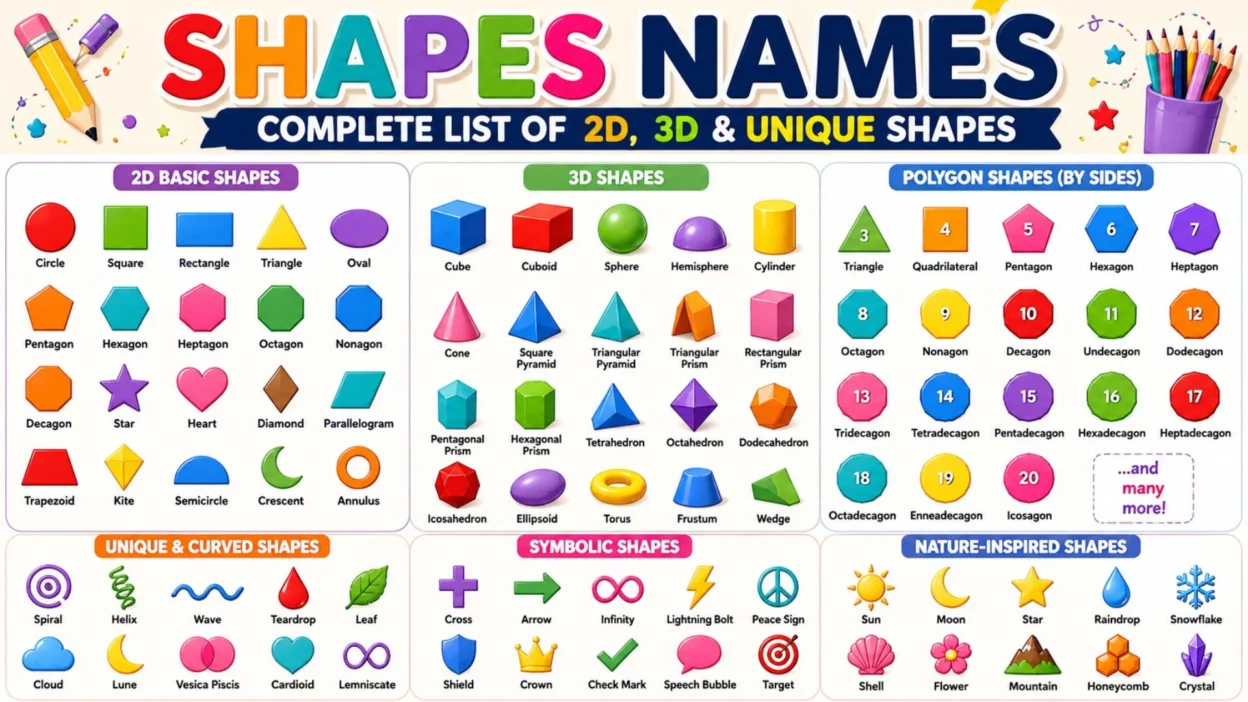
Learning shapes names sounds simple until you realize just how many shapes exist beyond circles, squares, and triangles. Whether you are helping a child with homework, preparing classroom material, designing a project, or simply expanding your vocabulary, having a clear list can save a lot of time.
Most people know the basic shapes, but names like rhombus, dodecagon, ellipsoid, or torus can quickly become confusing. In addition, 2D shapes, 3D shapes, polygons, curved forms, and symbolic shapes are often mixed together. Therefore, a well-organized collection makes learning much easier.
Choosing the correct shape name also matters in mathematics, art, architecture, graphic design, and everyday communication. A precise name helps you describe exactly what you see without unnecessary explanation.
This guide brings together common, geometric, unusual, and three-dimensional shapes names in one easy-to-scan place. You will also find selected shape meanings and useful categories later in the article, making it suitable for students, teachers, parents, designers, and curious learners.
Shapes Names List for Quick Reference
This collection includes familiar and less common shapes from geometry, design, mathematics, and everyday learning. Use it as a quick reference whenever you need the correct name.
- Circle
- Oval
- Ellipse
- Square
- Rectangle
- Triangle
- Pentagon
- Hexagon
- Heptagon
- Octagon
- Nonagon
- Decagon
- Undecagon
- Dodecagon
- Tridecagon
- Tetradecagon
- Pentadecagon
- Hexadecagon
- Heptadecagon
- Octadecagon
- Enneadecagon
- Icosagon
- Rhombus
- Diamond
- Parallelogram
- Trapezoid
- Trapezium
- Kite
- Quadrilateral
- Equilateral Triangle
- Isosceles Triangle
- Scalene Triangle
- Right Triangle
- Acute Triangle
- Obtuse Triangle
- Semicircle
- Quarter Circle
- Crescent
- Annulus
- Sector
- Segment
- Arc
- Star
- Heart
- Cross
- Arrow
- Spiral
- Helix
- Wave
- Teardrop
- Egg Shape
- Leaf Shape
- Cloud Shape
- Cone
- Cube
- Cuboid
- Sphere
- Hemisphere
- Cylinder
- Pyramid
- Prism
- Triangular Prism
- Rectangular Prism
- Pentagonal Prism
- Hexagonal Prism
- Tetrahedron
- Octahedron
- Dodecahedron
- Icosahedron
- Ellipsoid
- Torus
- Frustum
- Wedge
- Capsule
- Cone Frustum
- Square Pyramid
- Triangular Pyramid
- Pentagonal Pyramid
- Hexagonal Pyramid
- Möbius Strip
- Reuleaux Triangle
- Lune
- Vesica Piscis
- Lemniscate
- Astroid
- Cardioid
- Deltoid
- Parabola
- Hyperbola
- Trapezoidal Prism
- Rhombohedron
- Paraboloid
- Hyperboloid
- Spheroid
- Polyhedron
- Regular Polygon
- Irregular Polygon
- Concave Polygon
- Convex Polygon
- Star Polygon
Shapes Names With Meanings
These shapes names with meanings give a quick explanation of what makes each form distinctive. The meanings stay short so you can scan and remember them easily.
- Circle — round closed curve
- Square — four equal sides
- Rectangle — four right angles
- Triangle — three-sided polygon
- Pentagon — five-sided polygon
- Hexagon — six-sided polygon
- Heptagon — seven-sided polygon
- Octagon — eight-sided polygon
- Nonagon — nine-sided polygon
- Decagon — ten-sided polygon
- Rhombus — four equal sides
- Parallelogram — opposite sides parallel
- Trapezoid — one parallel pair
- Kite — two equal side pairs
- Oval — elongated round form
- Ellipse — smooth closed curve
- Semicircle — half a circle
- Crescent — curved moon-like shape
- Cube — six square faces
- Cuboid — six rectangular faces
- Sphere — perfectly round solid
- Cylinder — two circular bases
- Cone — circular base and point
- Pyramid — base with triangular sides
- Prism — matching parallel bases
- Tetrahedron — four triangular faces
- Octahedron — eight triangular faces
- Dodecahedron — twelve pentagonal faces
- Icosahedron — twenty triangular faces
- Torus — ring-shaped solid
- Ellipsoid — stretched sphere
- Hemisphere — half a sphere
- Star — pointed radial figure
- Heart — symbolic love shape
- Spiral — curve around center
- Annulus — ring-shaped region
- Sector — circle slice
- Arc — part of a curve
- Polyhedron — flat-faced 3D solid
- Polygon — closed straight-sided figure
Basic 2D Shapes Names
These shapes names are the most familiar flat figures used in early learning, mathematics, art, and everyday objects. They are simple to recognize and useful for building basic geometry skills.
- Circle
- Square
- Rectangle
- Triangle
- Oval
- Pentagon
- Hexagon
- Heptagon
- Octagon
- Nonagon
- Decagon
- Rhombus
- Diamond
- Parallelogram
- Trapezoid
- Kite
- Semicircle
- Crescent
- Star
- Heart
3D Shapes Names for Students and Learners
Three-dimensional shapes have length, width, and depth. These 3D shapes names are commonly taught in schools and also appear in architecture, engineering, packaging, and design.
- Cube
- Cuboid
- Sphere
- Hemisphere
- Cylinder
- Cone
- Pyramid
- Prism
- Tetrahedron
- Octahedron
- Dodecahedron
- Icosahedron
- Ellipsoid
- Torus
- Frustum
- Wedge
- Capsule
- Spheroid
- Rhombohedron
- Polyhedron
- Paraboloid
- Hyperboloid
Triangle Shapes Names
Triangles can be grouped by their side lengths or angles. Knowing these triangle shapes names makes geometry problems much easier to understand.
- Equilateral Triangle
- Isosceles Triangle
- Scalene Triangle
- Right Triangle
- Acute Triangle
- Obtuse Triangle
- Right Isosceles Triangle
- Oblique Triangle
Polygon Shapes Names
Polygons are closed figures made from straight sides. Their names usually depend on how many sides they have.
- Triangle
- Quadrilateral
- Pentagon
- Hexagon
- Heptagon
- Octagon
- Nonagon
- Decagon
- Undecagon
- Dodecagon
- Tridecagon
- Tetradecagon
- Pentadecagon
- Hexadecagon
- Heptadecagon
- Octadecagon
- Enneadecagon
- Icosagon
Quadrilateral Shapes Names
Quadrilaterals are four-sided figures, but their angles and side relationships can vary. These are some of the most important shapes names in this group.
- Square
- Rectangle
- Rhombus
- Parallelogram
- Trapezoid
- Trapezium
- Kite
- Irregular Quadrilateral
- Concave Quadrilateral
- Cyclic Quadrilateral
Unique Shapes Names
Some shapes stand out because of their unusual geometry or distinctive appearance. These unique shapes are useful in advanced mathematics, design, logos, patterns, and creative projects.
- Reuleaux Triangle
- Möbius Strip
- Lemniscate
- Cardioid
- Astroid
- Deltoid
- Lune
- Vesica Piscis
- Annulus
- Helix
- Spiral
- Parabola
- Hyperbola
- Cycloid
- Epicycloid
- Hypocycloid
- Rose Curve
- Trefoil
- Quatrefoil
- Salinon
Cool Shapes Names for Creative Projects
These cool shapes names work especially well for art, graphic design, worksheets, logos, decorative patterns, and visual projects.
- Star
- Crescent
- Spiral
- Diamond
- Arrow
- Infinity
- Lightning Bolt
- Teardrop
- Cross
- Chevron
- Shield
- Burst
- Sunburst
- Wave
- Cloud
- Flame
- Leaf
- Petal
- Ribbon
- Pinwheel
Stylish Shapes Names for Design
Stylish shapes often appear in branding, fashion, digital graphics, invitations, and modern visual layouts. They can make a design look clean, elegant, or playful.
- Hexagon
- Diamond
- Oval
- Arch
- Crescent
- Quatrefoil
- Chevron
- Capsule
- Lozenge
- Scallop
- Medallion
- Rosette
- Frame
- Badge
- Banner
- Shield
- Ribbon
- Mandorla
- Trefoil
- Starburst
Funny and Playful Shapes Names
Some shapes are commonly described with fun, everyday names rather than strict mathematical terms. These are especially useful for children, crafts, games, and playful designs.
- Egg Shape
- Bean Shape
- Blob
- Jellybean
- Donut
- Peanut
- Cloud
- Raindrop
- Bow Tie
- Fish Shape
- Paw Print
- Flower
- Butterfly
- Mushroom
- Balloon
- Candy Shape
- Puzzle Piece
- Speech Bubble
- Smile Shape
- Splash
Nature-Inspired Shapes Names
Nature is full of recognizable forms that inspire art, patterns, and design. These shapes names are easy to associate with familiar natural objects.
- Leaf
- Petal
- Flower
- Sun
- Moon
- Crescent
- Star
- Raindrop
- Snowflake
- Shell
- Wave
- Mountain
- Cloud
- Flame
- Seed
- Pebble
- Crystal
- Honeycomb
- Spiral
- Branch
Geometric Shapes Names for Math and Science
These geometric forms appear in mathematics, physics, engineering, and scientific diagrams. Some are basic, while others are more advanced.
- Polygon
- Polyhedron
- Ellipse
- Parabola
- Hyperbola
- Circle
- Annulus
- Sector
- Segment
- Arc
- Prism
- Pyramid
- Frustum
- Tetrahedron
- Octahedron
- Icosahedron
- Dodecahedron
- Torus
- Ellipsoid
- Spheroid
- Paraboloid
- Hyperboloid
Regular and Irregular Shapes Names
Regular shapes have equal sides and angles, while irregular shapes do not follow the same balanced pattern. Both types are important in geometry and visual design.
- Regular Triangle
- Regular Square
- Regular Pentagon
- Regular Hexagon
- Regular Heptagon
- Regular Octagon
- Regular Nonagon
- Regular Decagon
- Irregular Triangle
- Irregular Quadrilateral
- Irregular Pentagon
- Irregular Hexagon
- Irregular Heptagon
- Irregular Octagon
- Concave Polygon
- Convex Polygon
- Star Polygon
Curved Shapes Names
Curved shapes use smooth lines instead of only straight edges. They often appear softer and more organic than polygons.
- Circle
- Oval
- Ellipse
- Semicircle
- Crescent
- Spiral
- Arc
- Annulus
- Cardioid
- Lemniscate
- Lune
- Wave
- Teardrop
- Egg Shape
- S Curve
- C Curve
- Bell Curve
- Rose Curve
Symbolic Shapes Names
Some shapes are strongly connected with emotions, directions, beliefs, or familiar symbols. These forms are widely used in signs, icons, branding, and social media.
- Heart
- Star
- Cross
- Arrow
- Infinity
- Peace Sign
- Crescent
- Shield
- Crown
- Diamond
- Lightning Bolt
- Check Mark
- Speech Bubble
- Sun
- Moon
- Eye Shape
- Keyhole
- Ribbon
- Badge
- Target
Rare Shapes Names Worth Knowing
If you want to go beyond the usual circles and polygons, these rare shapes names can make your geometry vocabulary much more interesting.
- Nephroid
- Limaçon
- Cassini Oval
- Catenary
- Witch of Agnesi
- Deltoid
- Astroid
- Cardioid
- Lemniscate
- Reuleaux Polygon
- Superellipse
- Torus Knot
- Klein Bottle
- Möbius Strip
- Trefoil Knot
- Enneper Surface
- Catenoid
- Helicoid
- Gyroid
- Sphericon
Shapes Names for Kids and Early Learning
Simple shapes names help children recognize patterns, objects, letters, and everyday designs. These familiar options are especially useful for preschool activities, worksheets, games, and classroom learning.
- Circle
- Square
- Triangle
- Rectangle
- Oval
- Star
- Heart
- Diamond
- Crescent
- Semicircle
- Pentagon
- Hexagon
- Octagon
- Arrow
- Cross
- Cloud
- Flower
- Raindrop
- Sun
- Moon
Everyday Shapes Names and Real-Life Examples
Many geometric forms appear around us every day. Learning these shapes names can make geometry easier because learners can connect each form with familiar objects.
- Plate — Circle
- Window — Rectangle
- Tile — Square
- Road Sign — Triangle
- Egg — Oval
- Clock — Circle
- Door — Rectangle
- Dice — Cube
- Ball — Sphere
- Can — Cylinder
- Ice Cream Cone — Cone
- Tent — Prism
- Roof — Triangle
- Ring — Annulus
- Kite — Kite
- Honeycomb — Hexagon
- Stop Sign — Octagon
- Pizza Slice — Sector
- Moon — Crescent
- Book — Cuboid
Shapes Names by Number of Sides
One of the easiest ways to remember polygon names is by counting their sides. This quick reference can help students identify common polygons faster.
- 3 Sides — Triangle
- 4 Sides — Quadrilateral
- 5 Sides — Pentagon
- 6 Sides — Hexagon
- 7 Sides — Heptagon
- 8 Sides — Octagon
- 9 Sides — Nonagon
- 10 Sides — Decagon
- 11 Sides — Undecagon
- 12 Sides — Dodecagon
- 13 Sides — Tridecagon
- 14 Sides — Tetradecagon
- 15 Sides — Pentadecagon
- 16 Sides — Hexadecagon
- 17 Sides — Heptadecagon
- 18 Sides — Octadecagon
- 19 Sides — Enneadecagon
- 20 Sides — Icosagon
How to Choose the Right Shapes Names
Choosing the correct shape name becomes much easier when you first decide whether the figure is two-dimensional or three-dimensional. A 2D shape is flat, while a 3D shape has depth and volume.
Next, count the sides if the shape is a polygon. For example, five straight sides usually indicate a pentagon, while eight indicate an octagon. Also, look at the angles and side lengths. A square and rectangle both have four right angles, but only a square has four equal sides.
For curved forms, focus on the overall structure. A circle is perfectly round, while an ellipse looks stretched. Likewise, an annulus looks like a ring.
When working with children or beginners, start with basic shapes names before introducing advanced terms. In contrast, students studying higher mathematics may need precise names such as cardioid, ellipsoid, or dodecahedron.
Common Mistakes to Avoid When Learning Shapes Names
A common mistake is assuming that every four-sided figure is a square or rectangle. In fact, quadrilaterals also include rhombuses, kites, trapezoids, and parallelograms.
Another frequent error is confusing 2D and 3D forms. For example, a circle is flat, while a sphere is a three-dimensional solid. Similarly, a square and cube are related but not identical.
Avoid relying only on how a shape looks when rotated. A square turned diagonally is still a square, even if it resembles a diamond.
It also helps to distinguish informal names from strict mathematical terms. “Diamond” is often used casually, whereas “rhombus” is the more precise geometric name in many situations.
Finally, learn shapes by their defining properties instead of memorizing appearance alone.
Extra Tips for Memorizing Shapes Names
Visual learning can make shapes names much easier to remember. Try connecting each shape to an everyday object, such as a circle with a clock or a cylinder with a can.
Flashcards are also useful, especially for children. Put the shape on one side and its name on the other. In addition, sorting activities can help learners separate curved shapes, polygons, and 3D solids.
Drawing each shape by hand is another effective method because it reinforces both appearance and spelling. Meanwhile, older students can practice grouping polygons by sides, angles, or symmetry.
For more advanced shapes, focus on one category at a time. Learn basic polygons first, then 3D solids, followed by mathematical curves and unusual forms.
Most importantly, repeat the names in real situations. Regular use makes recognition faster and helps the vocabulary become easier to remember.
FAQs About Shapes Names
What are the most common shapes names?
The most common shapes names include circle, square, rectangle, triangle, oval, pentagon, hexagon, and octagon. These are usually taught first because they appear frequently in everyday life.
What are the main 3D shapes names?
Common 3D shapes include cube, cuboid, sphere, cylinder, cone, pyramid, and prism. More advanced solids include tetrahedron, octahedron, dodecahedron, and icosahedron.
What is a shape with five sides called?
A five-sided polygon is called a pentagon. If all five sides and angles are equal, it is known as a regular pentagon.
What is the difference between a circle and a sphere?
A circle is a flat 2D shape, while a sphere is a three-dimensional solid. A coin face resembles a circle, while a ball resembles a sphere.
Is a diamond a geometric shape?
“Diamond” is commonly used as an informal shape name. In geometry, the figure people often call a diamond is usually a rhombus.
How can children learn shapes names easily?
Children can learn shapes through flashcards, drawing, matching games, puzzles, and real-life objects. Connecting each shape to something familiar often makes the names easier to remember.
Conclusion
Learning shapes names becomes much easier when they are grouped into clear categories such as 2D shapes, 3D solids, polygons, curved forms, and everyday shapes. Starting with familiar names like circle, square, and triangle creates a strong foundation before moving toward advanced terms such as torus, ellipsoid, or dodecahedron.
Use this guide as a quick reference for schoolwork, teaching, design, or general learning. You can also practice by spotting different shapes in everyday objects and naming them correctly.

Julian Crest is a naming expert at Namezhut who researches and curates unique baby and pet names from around the world. His goal is to help readers discover meaningful names with ease.